Lead Time & Gantt Templates — Plan Your Custom Plush Timeline Backwards

Use these copy-ready Gantt templates to plan your plush project backwards—from launch date to sampling, production, packing, and shipping.

Uniomy’s controlled planning system helps solve the common timeline blockers below:

  • “We don’t know what to lock first.” → A milestone-based spec lock checklist (must-not-change items) before sampling/testing.
  • “Revisions keep resetting the schedule.”Structured revision rounds with one consolidated feedback list per round.
  • “Shipping time blew up our launch date.” → Early shipping method + carton rule lock, with split-shipment planning when needed.

Define the Key Milestones for custom plush project

8 blocks same for every custom plush project

M1: Inquiry & Feasibility Alignment

  • Confirm product type, target size, quantity range, and target market/channel
  • Check basic feasibility: structure, materials, decoration, attachments, safety risk flags
  • Align decision path: which sample type and how many rounds are realistic
  • Output: feasibility notes + next-step requirements for kickoff

M2: Spec Fixed Before Sampling

  • Lock size target + key measurements (and tolerance if needed)
  • Lock fabric direction: hand-feel tier, pile height, pile direction / sheen behavior
  • Lock components list: accessories, mechanisms, magnets/electronics (if any)
  • Lock SKU count + variant rules (colors/sizes, what can change vs must stay identical)
  • Lock pack-out rules: unit packaging, inserts, labels, carton marks format

M3: Sampling Rounds

  • Build first sample to prove structure + appearance + material intent
  • Review using measurable points: dimensions, proportions, placement, feel zones, finishing
  • Consolidate feedback into one list per round (avoid conflicting approvers)
  • Output: updated sample + revision log that shows what changed and why

M4: Golden Sample Approval

  • Confirm the “approved reference” standard (PP / golden sample logic)
  • Freeze must-not-change items: fabric, decoration method, placement anchors, components, labels
  • Define what is allowed to vary vs must stay identical in production
  • Output: locked baseline for QC + repeatable reorder reference

M5: Production Lead Time

  • Plan line allocation and workflow for the locked spec and SKU mix
  • Control changeovers (colors/variants) to protect efficiency and consistency
  • Apply change control: no silent substitutions on materials/components
  • Output: bulk production progress aligned to the approved baseline

M6: QC + Packing Readiness

  • Run QC checkpoints against the approved reference and tolerances
  • Confirm pack-out execution: labels, barcode/SKU rules, inserts, hangtags, polybag/box rules
  • Lock carton rules: units/carton, mixed-SKU policy, carton numbering, carton marks placement
  • Output: packing-ready batch with fewer receiving disputes

M7: Shipping Documents

  • Confirm consignee / ship-to / notify party details (exact spelling and format)
  • Draft and cross-check CI/PL/carton data consistency before dispatch
  • Provide packing estimates early for booking: carton count, dimensions, weights
  • Output: clean drafts submitted before cut-offs to avoid holds and rework

M8: Dispatch & Transit

  • Dispatch after documents and packing data are confirmed and released
  • Transit time depends on method (air/sea/express/split) and appointment rules
  • Plan buffer for clearance, release, last-mile delivery, and warehouse receiving windows
  • Output: predictable arrival aligned to launch or warehouse intake date

3 Custom Plush Lead Time Gantt Templates

Learn the fastest way to plan a custom plush timeline.
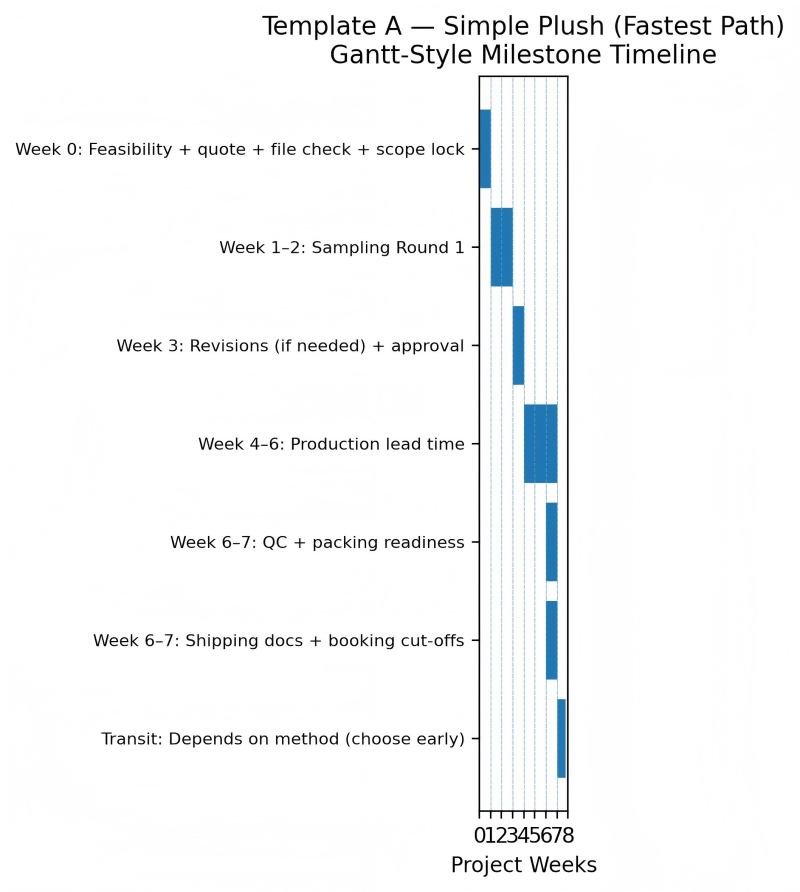
Simple designs move fastest when materials and approvals don’t drift.

Template A: Simple Plush (Fastest Path)

Use this template for simple plush designs with standard fabrics, minimal accessories, and straightforward embroidery. It fits pilot programs and fast launches because sampling risk is low and production lead time is easier to stabilize.

Best for

  • standard fabric + simple embroidery
  • no magnets/electronics
  • low accessory complexity (single SKU preferred)

Gantt blocks

  • Week 0: Feasibility + quote + file check + scope lock
  • Week 1–2: Sampling Round 1
  • Week 3: Revisions (if needed) + approval
  • Week 4–6: Production lead time
  • Week 6–7: QC + packing readiness
  • Week 6–7: Shipping docs + booking cut-offs
  • Transit: depends on method (choose early)

Key inputs to lock early

  • target feel/fabric direction, size, logo placement, label rules

Most common path for retail and e-commerce brands.

Template B: Standard Brand Plush

Use this for typical brand plush programs: multiple colors/variants, mixed decoration (embroidery + patch/print), packaging labels/carton marks, and 1–2 sampling rounds. It’s the most realistic template for clean approvals and repeatable reorders.

Best for

  • multiple colors/variants (SKU control matters)
  • embroidery + patch/print mix
  • standard accessories (keychain, zipper, etc.)
  • packaging labels + carton marks required

Gantt blocks (copy-ready)

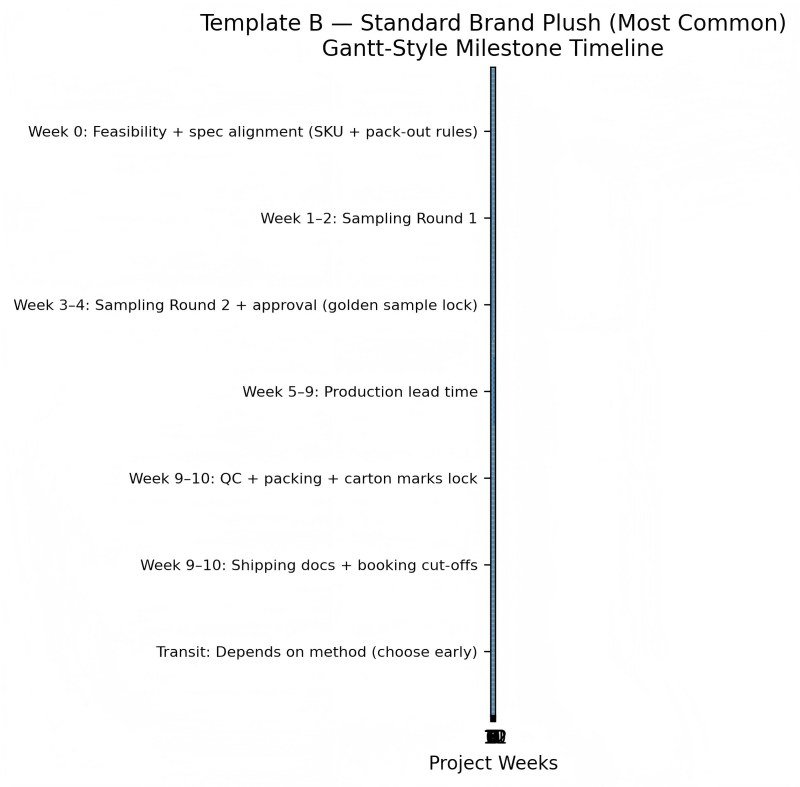
  • Week 0: Feasibility + spec alignment (SKU + pack-out rules)
  • Week 1–2: Sampling Round 1
  • Week 3–4: Sampling Round 2 + approval (golden sample lock)
  • Week 5–9: Production lead time
  • Week 9–10: QC + packing + carton marks lock
  • Week 9–10: Shipping docs + booking cut-offs
  • Transit: depends on method

Accessories, Electronics, Compliance checkpoints

Template C: Complex / High-Risk Plush

Use this when you have magnets/electronics, complex attachments, special prints/coatings, strict market/channel requirements, or multiple approvers. Plan more sampling time, lock final-spec earlier, and allocate buffer for testing and documentation—ideally running testing in parallel where possible.

Best for

  • magnets / electronics / special mechanisms
  • high-detail printing or coatings
  • strict retailer/market compliance processes
  • many stakeholders approving samples

Gantt blocks (copy-ready)

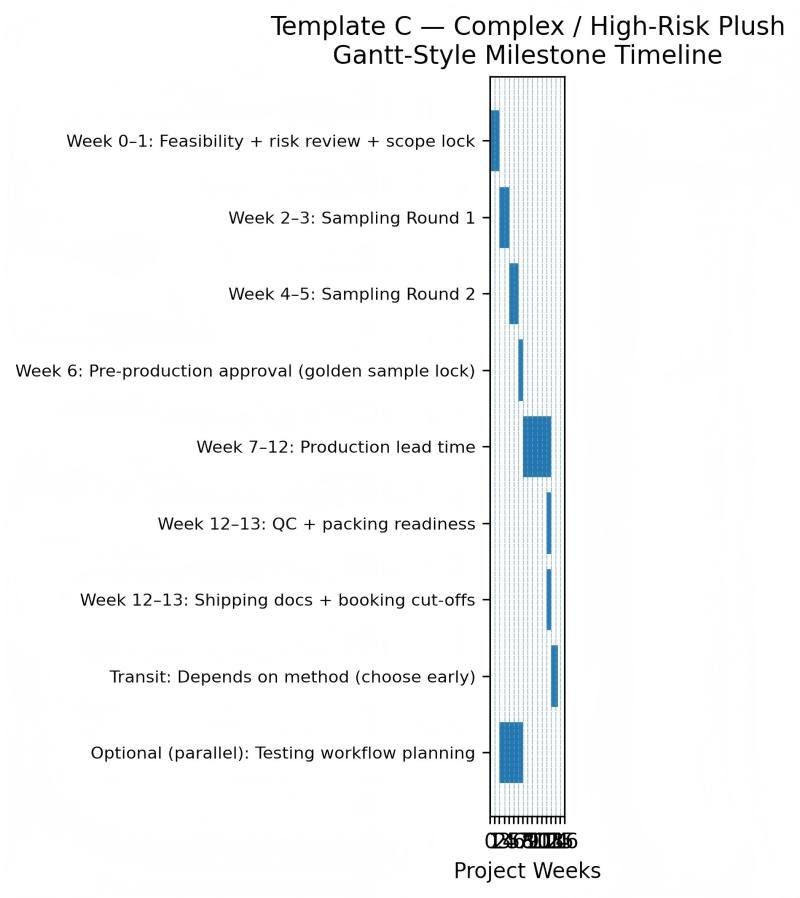
  • Week 0–1: Feasibility + risk review + scope lock
  • Week 2–3: Sampling Round 1
  • Week 4–5: Sampling Round 2
  • Week 6: Pre-production approval (golden sample lock)
  • Week 7–12: Production lead time
  • Week 12–13: QC + packing readiness
  • Week 12–13: Shipping docs + booking cut-offs
  • Transit: depends on method
  • Optional (parallel): Testing workflow planning

Critical must-not-change items before any testing submission

  • fabric type, decoration method, components list, age grade/label rules

How to Plan the Full Shipping Timeline?

Shipping assumptions miss launch dates more often than production does.

Launch dates are missed more often due to shipping assumptions and document cut-offs than sewing time. Choose shipping method early, lock carton specs to control dimensional weight, and draft shipping documents before dispatch. Split shipments are the best strategy when you need speed and cost control.

  • Shipping method chosen late = timeline breaks.
  • Carton specs not locked = cost & booking surprises.
  • Docs not drafted early = missed cut-offs.
Risk TriggerWhat HappensLock Point
Late ship method decisionre-plan booking & arrivalbefore production ends
Carton dims/qty changed lateDIM weight jumps / re-packbefore packing starts
CI/PL/carton marks not aligneddocument hold / miss cut-offpre-dispatch draft stage
Launch needs speed + costoverpay air or miss dateplan split shipment early

Best practices

Gantt Plan Inputs Checklist

Clear inputs produce a timeline your team can approve internally.
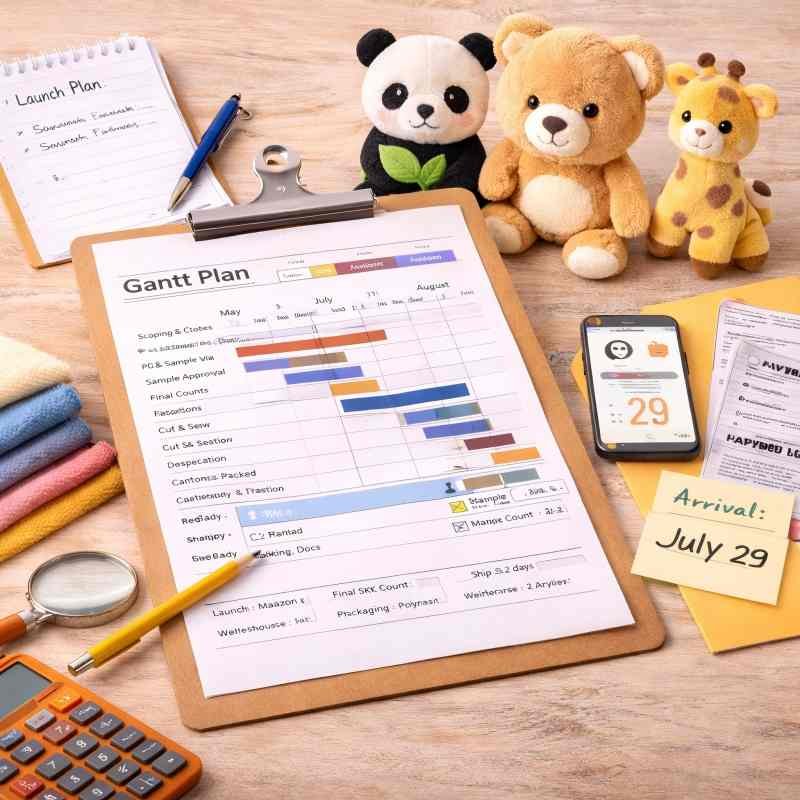
Back-planning is fast when key inputs are clear. Send your launch/arrival date, channel, SKU structure, accessories, packaging, and shipping preference. We’ll return a realistic lead time plan with Gantt-style milestones and suggested buffers—ready to share with purchasing, marketing, and QA.

Please share

  • target market/channel + intended arrival date (warehouse/DC/FBA appointment)
  • size(s), quantity tiers, number of SKUs/variants
  • accessories list (keychains, zippers, magnets, electronics)
  • decoration intent (embroidery/patch/printing)
  • packaging needs + carton mark template (if any)
  • shipping preference (air/sea/express or split)

Top Causes of Custom Plush Lead Time Delays (And How to Avoid Them)

Most delays are predictable—and preventable with early locks.

Most delays come from the same causes: late spec changes, unclear labels/carton rules, too many sample revisions, and compliance/testing started too late. Prevent them with early scope lock, fewer moving parts, one decision owner for approvals, and consolidated feedback per revision round.

Top delay risks
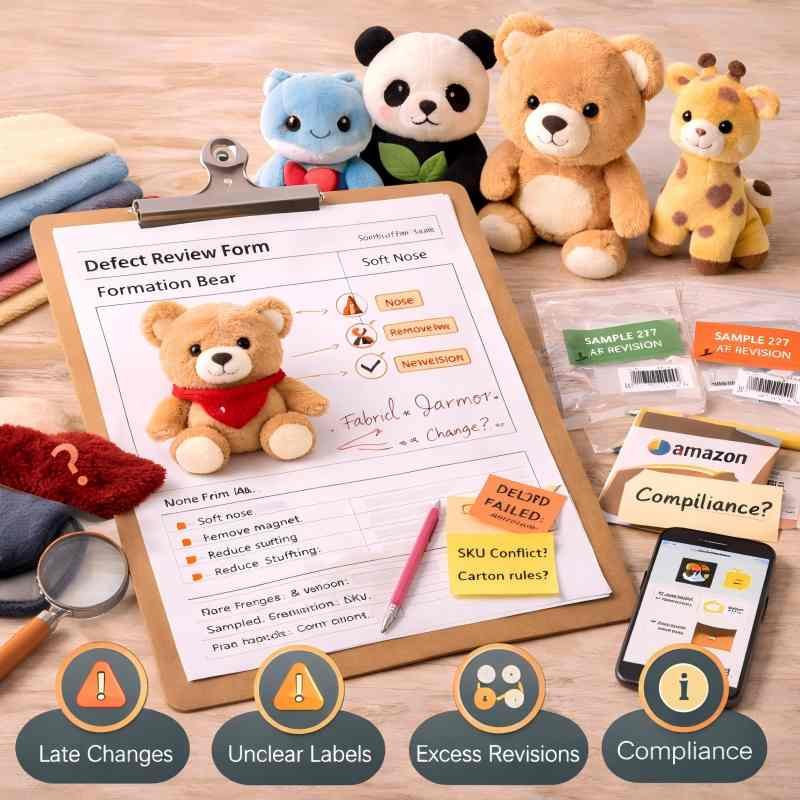
  • non-final samples submitted (causes retesting and rework)
  • fabric/decoration changes after approval
  • mixed SKU carton rules confirmed too late
  • compliance documents requested after production starts
  • too many approvers without a decision owner
  • feedback not consolidated (conflicting edits reset rounds)

FAQs about stuffing weight control

Q1: Can you guarantee a fixed lead time?

Lead time depends on complexity, revision rounds, and shipping method. We provide a realistic plan and help lock risk items early to keep timelines predictable.

Q2: How many sampling rounds should I plan for?

Simple projects may need 1 round; standard projects often need 1–2; complex projects should plan more buffer and stricter spec lock.

Q3: What’s the fastest way to hit a hard launch date?

Lock must-not-change items early, reduce variants, and use split shipping when needed.

Ready to Get Your Editable Gantt Timeline?

Share your launch date, market/channel, product configuration, and shipping preference. We’ll return an editable Gantt plan (milestones + recommended buffer) aligned with production lead time, document readiness, and shipping cut-offs.

Contact Us Today, Get Reply Within 12-24 Hours

I am Nika, our team would be happy to meet you and help to build your brand plush.